Show Your Hand to Win the Game: How Deliberate Transparency Makes Your Next Illusion Unbeatable
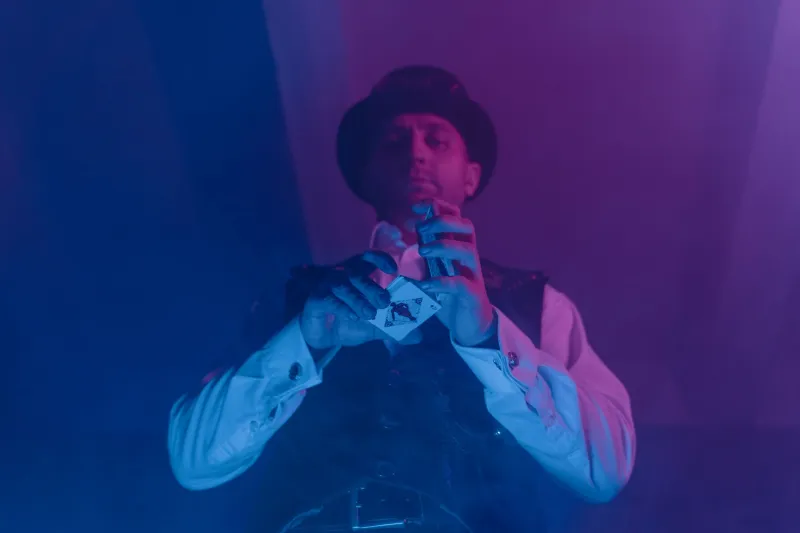
There's a rule most magicians treat like gospel: never, ever let them see how it's done. Guard the method. Protect the secret. Keep the curtain closed at all costs.
But here's the thing — some of the most psychologically sophisticated performers working today are quietly breaking that rule on purpose. And it's making their shows stronger, not weaker.
Welcome to one of the more mind-bending ideas in modern performance theory: the strategic partial reveal. The deliberate, controlled moment where you let the audience think they've caught you — and then use that false sense of understanding to absolutely destroy them on the very next trick.
The Psychology Behind "Oh, I See How You Did That"
Human brains are pattern-recognition machines. When your audience watches a trick, a significant portion of their mental energy goes toward figuring it out. They're not just watching — they're working. And when they think they've cracked it, something interesting happens: they relax.
That mental exhale is gold for a magician.
Once a spectator believes they understand the mechanism behind what they just saw, their critical defenses drop. They've solved the puzzle. They feel smart, satisfied, a little smug even. That cognitive reward releases them from the hyper-vigilant watching mode they were in just seconds before.
And that's exactly when you hit them with something they genuinely cannot explain.
The contrast effect is brutal in the best possible way. A trick that follows a "solved" one doesn't just land — it obliterates. The audience's guard is down, their analytical brain is cooling off, and then you do something they have absolutely no framework for. The impact is exponentially greater than if you'd led with the impossible effect from the start.
What a "Partial Reveal" Actually Looks Like in Practice
Let's be clear: this isn't the same as carelessly flashing a palmed card or fumbling a reset. Those are mistakes. A strategic partial reveal is a choice, and it looks completely intentional — because it is.
One classic version of this involves a performer openly showing a "rough and smooth" force deck during a casual, conversational moment before the real performance begins. They might say something like, "You know those trick decks? I've got one right here — totally rigged. Watch." They demonstrate a simple, obviously gimmicked effect. The audience laughs, nods, feels in on the joke.
Then the performer switches to a completely clean deck — visually, obviously, in full view — and proceeds to do something that a rigged deck couldn't possibly explain. The audience's prior "solution" becomes a trap they set for themselves.
Another approach involves narration. Some performers will casually explain the general principle of a technique — say, how a double lift works in theory — while demonstrating it in an exaggerated, almost comedic way. The audience feels educated. Then, minutes later, the performer executes a flawless double lift at full speed as part of a devastating routine. The audience knows what a double lift looks like. They watched one get demonstrated. And they still don't catch it. That gap between what they think they know and what they actually perceive is where the real magic lives.
The Confidence Signal You're Sending
There's a secondary benefit to this approach that doesn't get talked about enough: what deliberate transparency communicates about you as a performer.
When a magician nervously guards every single detail of their act, audiences can sense that protectiveness. It creates a subtle adversarial energy — you're hiding, they're hunting. That dynamic is fine, but it keeps the relationship transactional.
When you openly show something, even a small something, you project a totally different kind of confidence. You're saying, I'm so far ahead of you that I can afford to give you this. That's not arrogance — it's the performance of mastery. And audiences respond to it. They lean in. They trust you more. Paradoxically, the performer who shows a little is often perceived as more skilled than the one who obsessively conceals everything.
This is part of why so many top-tier magicians build "here's roughly how this kind of thing works" moments into their patter. Penn & Teller built an entire brand identity around it. The exposure isn't the weakness — it's the flex.
Building the Reveal Into Your Set Structure
If you want to experiment with this in your own act, set structure matters a lot. You can't just randomly expose a method and hope the next trick benefits. The sequencing has to be intentional.
Set up the false solution early. Introduce the "exposed" element in a low-stakes, casual context. Make it feel like an aside, not a feature. The audience should feel like they stumbled onto information, not that you handed it to them.
Let the false understanding settle. Give it some breathing room. Don't immediately follow with the trick you want to land hard. Let them sit with their "knowledge" for a bit — ideally through one or two lighter moments that reinforce their confidence.
Execute the real effect cleanly and without calling attention to the contrast. Don't say, "Now watch this one." Just do it. The audience will make the connection themselves, and that self-discovery makes the astonishment hit even harder.
Leave space after the big effect. Resist the urge to immediately explain or move on. Let the moment breathe. Their brains are trying to reconcile what they thought they knew with what they just witnessed, and that cognitive dissonance is the sweetest part of the whole thing.
A Word of Caution
This technique is a precision instrument, not a sledgehammer. Used carelessly, it can genuinely undermine your act — if the "partial reveal" accidentally exposes more than you intend, or if the follow-up trick isn't strong enough to justify the setup, you'll just look sloppy.
It also requires solid sleight of hand and performance confidence. You need to be skilled enough that your actual method remains invisible even when the audience thinks they know what to look for. If you're still working on the fundamentals, build those first. This approach rewards the performer who's already competent and is looking for a psychological edge, not a shortcut.
The Bigger Lesson
Magic isn't just about secrets. It never really was. It's about controlling what people think they know — and that's a much more interesting, much more powerful game than simply hiding everything and hoping nobody figures it out.
The magician who can make an audience feel smart, lower their defenses, and then completely shatter their model of reality is operating at a different level. Strategic transparency is one of the tools that gets you there.
So yeah — sometimes the smartest move really is showing your hand.